

On August 18th, during the opening ceremony of the 2025 Global Smart Education Conference, Li Yongzhi, Secretary of the Party Committee and Director of the China National Academy of Educational Sciences (CNAES), officially unveiled the China Smart Education (2024-2025).

Li Yongzhi pointed out that in the intelligent era, AI is redefining the boundary between "human" and "man-made machines," and reconstructing the division of labor in society. Under this AI-driven redefinition, the purpose of education has shifted from "passively serving production" to "actively serving life." The era's connotation of "for whom to educate" has been greatly enriched, the curricular logic of "what kind of people to cultivate" has been profoundly revealed, and the paradigm of "how to cultivate people" has been significantly expanded. At this pivotal moment of educational transformation, "what to learn" is more important than "how to learn," making the reconstruction of curricular logic an urgent priority. The innovative development path of China's smart education will undoubtedly contribute more wisdom to global educational advancement and reform!
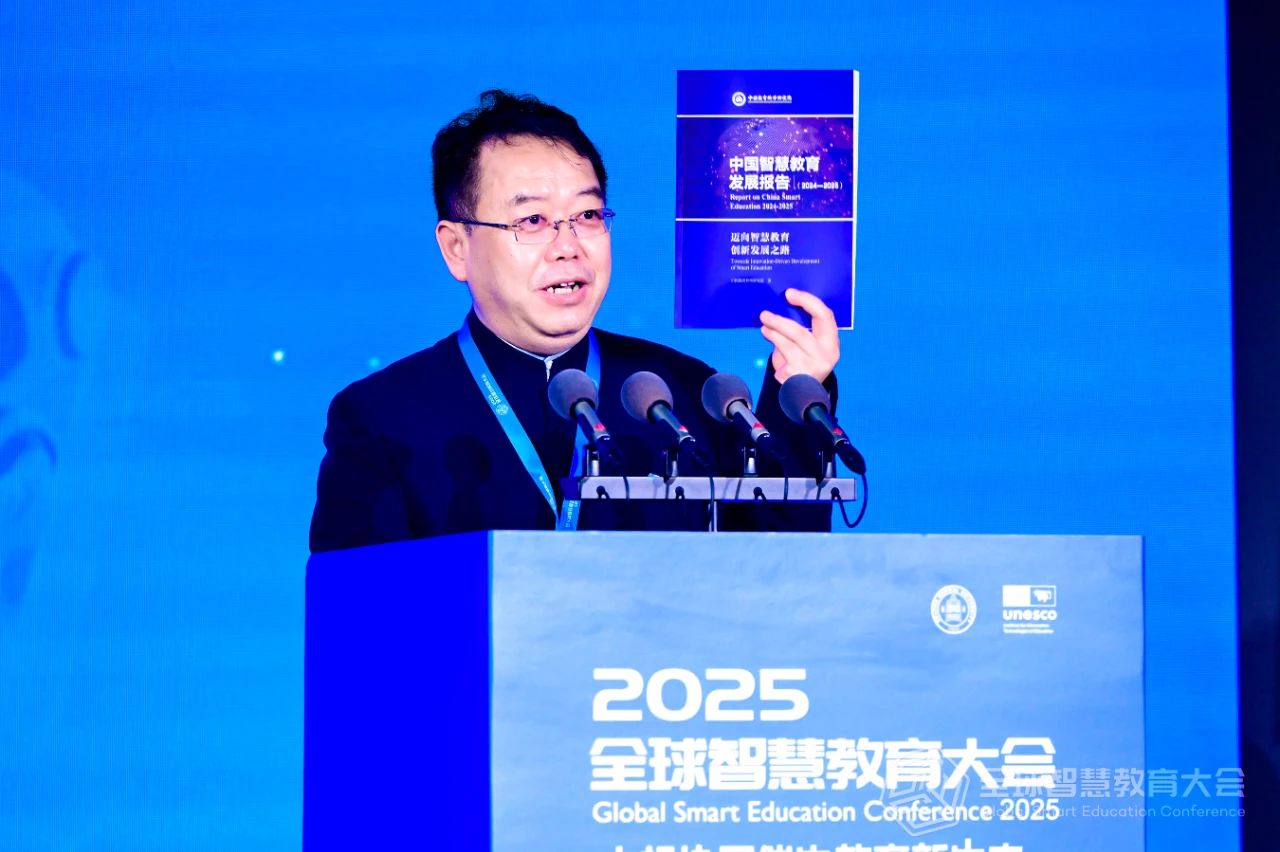
Report on China Smart Education (2024-2025) is a key annual research product commissioned by the Ministry of Education and developed and released by CNAES, with the aim of embodying "national will through academic expression." This year's report, themed " towards Innovation-Driven Development of Smart Education," focuses on educational development and transformation in the intelligent era. It provides a comprehensive overview of the conceptual evolution and practical progress of smart education in China, while contributing to global knowledge advancement and practical reforms in smart education.
The report proposes that the development philosophy of China's smart education is grounded in the "3C" principles—"Connection First, Content as Core, and Collaboration as Key"—and innovates through the "3I" pathways of "Integration, Intelligence, and Internationalization." The guiding principle of "Application is King" runs through the entire development process of smart education. With AI redefining education, the essence of smart education has been further deepened, presenting 6 new characteristics:
lA new educational philosophy shifting from "efficiency-first" to "adaptive development";
lA new educational system evolving from "school-centric" to a "ubiquitous ecosystem";
lA new educational governance model transitioning from "linear mechanisms" to "agile mechanisms";
lA new educational content approach moving beyond "fragmented knowledge accumulation" toward "world model construction";
lA new educational methodology advancing from "symbolic learning" to "scenario-based training";
lA new educational administration paradigm progressing from "traditional management" to "optimization and restructuring."
The report provides a comprehensive analysis of China’s macro-level initiatives to advance its digital education strategy in depth during 2024-2025. It distills practical pathways for the integrated, intelligent, and international development of smart education in China and showcases 20 exemplary cases across K-12 education, vocational education, higher education, continuing education, and special needs education. These cases vividly illustrate the latest achievements in China’s exploration of smart education practices.
lAdditionally, the report identifies seven key global trends in near-future smart education development:
lTeaching Thinking Chains will innovate the conceptualization of educational large models;
lAI Agents will drive deeper integration of AI and education;
lDigital Pedagogy will lead the transformation of classroom teaching paradigms;
lSTEM Innovation will emerge as a strategic priority for future talent cultivation;
lSocial-Emotional Learning (SEL) will be emphasized to foster human-machine harmony;
lAlgorithm Governance will be critical in ensuring ethical and positive educational technology;
lThe Intelligent Divide will become a new variable reshaping educational equity.